741 Questions
Thirty practical answers shaped by the real questions people have asked while 741 has grown — from serving sizes and food safety to seed stock, costs and running a local hub.
7 QUESTIONS
The model, the rhythm and what you actually receive.
A 741 hub is made up of seven households matched around the same serving size.
Each household chooses one recipe and cooks enough of that recipe to make seven meals at their hub’s serving size.
For example, in a single-serve hub, each person cooks enough for seven single meals. In a five-serve hub, each household cooks enough for seven five-serve family meals.
Each household keeps one of their own meals and brings the other six to the swap. Everyone exchanges their six meals and goes home with seven different meals at the serving size that suits their household.
Each hub can also decide how it wants to swap. Some may prefer to exchange freshly cooked meals, while others may choose to operate as a freezer hub, where meals are frozen before the swap. The important thing is that the seven households agree on what works best for their hub.
Cook 1 • Keep 1 • Swap 6 • Take home 7
No. Each hub decides what works best for the people in that group.
Some hubs may prefer a fresh swap, where meals are cooked, cooled safely and exchanged fresh. Others may choose to operate as a freezer hub, where meals are frozen before the swap so people can store them and use them when needed.
The important thing is that everyone in the hub agrees on the same system and follows the appropriate food-safety and storage guidelines.
741 is designed to be flexible — the hub chooses the swap style that works best for them.
Not necessarily. The 741 recipe collection is there to make batch cooking easier, especially for people who are not used to cooking such large quantities.
The recipes are designed around seven meals at a chosen serving size, with freezing, reheating and family suitability considered where relevant.
But hubs can also agree to use their own trusted recipes, as long as the meal suits the hub’s serving size and any agreed dietary requirements.
The main expectation is that everyone contributes a proper home-cooked meal that they would be happy to serve to their own household and share with the other six households in their hub.
If you have a family favourite recipe that is especially well received in your hub, you are also welcome to submit it to 741 for consideration. Once reviewed and approved, it may be added to the 741 recipe collection so other hubs around New Zealand can enjoy it too.
Ideally, a 741 hub swaps weekly, because that is when households can experience the full benefits of the system.
A weekly swap means you cook one bulk recipe and receive a variety of meals for the week, which can help reduce the mental load of constantly deciding what to have for dinner, the time spent meal planning, shopping, preparing and cooking, food costs through bulk cooking and shared efficiencies, and the number of evenings spent cooking from scratch.
In return, it can create more time for family, friends, rest, hobbies and community — which is a big part of the heart behind 741.
Having a regular weekly rhythm can also make grocery planning and budgeting easier because you know in advance that one batch cook is contributing towards multiple dinners.
However, every hub is different. Your hub may decide that fortnightly or another regular schedule works better for everyone involved.
The important thing is that the people in the hub agree together on a rhythm that is realistic, sustainable and beneficial for everyone.
741 is designed to give time back — not become another obligation.
No. 741 is not a charity, a business or a free meal service. It is a movement.
It is a practical way for people to come together and share the load of feeding their households.
Each person in a hub contributes by cooking one bulk recipe that makes seven meals at the agreed serving size. They keep one and swap six, so everyone contributes and everyone receives.
741 may sometimes be supported by local growers, food suppliers, businesses or community organisations through things such as produce, ingredients, packaging or other practical support, but that does not change the heart of the model.
741 is about people helping people — building connection, reducing pressure, sharing resources and strengthening community through something we all need: good food.
No. You do not need to be an experienced cook or already know how to cook for seven households.
One of the reasons the 741 recipe collection exists is to take much of the guesswork out of it. Recipes are scaled to make seven meals at the chosen serving size and include practical guidance around portioning, storage, freezing and reheating where relevant.
Start with meals you already feel comfortable making. A familiar casserole, mince dish, soup, pasta bake or family favourite can be much easier than trying something complicated for your first swap.
Your hub can also share ideas and experience with one another. As you get used to the quantities and container sizes, batch cooking generally becomes much more straightforward.
You don’t need to be a chef — you just need to be willing to cook a good meal and share it with care.
The easiest way is to prepare the full recipe, then divide it as evenly as possible between seven containers of the same size.
Using matching containers can make this much easier, especially for casseroles, pasta bakes, curries and other tray meals. For soups, stews or saucy meals, you may prefer to measure by volume or use a ladle system so each container receives a similar amount.
For meals that include separate components — such as curry and rice, meatballs and sauce, or chicken with noodles — divide each part evenly across all seven meals.
It does not have to be laboratory-perfect. The aim is simply that each household receives a generous and reasonably equal portion at the serving size agreed by the hub.
The 741 recipes and serving-size guidance can also help take the guesswork out of portioning.
8 QUESTIONS
Finding your people, trying it out and getting a new hub moving.
No. You can register your interest even if you don’t know anyone else who wants to take part yet.
The 741 website is designed to help connect people in the same area, with the same serving-size needs and, where relevant, compatible dietary requirements or allergies.
As more people register in an area, potential hubs can begin to form. You can also invite friends, whānau, neighbours or workmates to register if you would prefer to build a hub with people you already know.
But if you already have six friends, family members, neighbours or workmates who want to do 741 with you, you don’t necessarily need to register your interest on the website at all — you can simply form your own seven-household hub and get started.
The website is there to help people find each other, access recipes and guidance, and support their hub — not to make 741 more complicated than it needs to be.
A full 741 hub is based around seven households, but you don’t need to find all seven before putting your hand up.
Life happens. Someone may be sick, away, have a family emergency or simply have a week when they cannot manage their 741 cook.
The most important thing is to let the rest of the hub know as early as possible, before everyone has completed their cooking.
Where there is enough interest locally, we recommend hubs keep a standby or cancellation list of people who would be happy to step into an occasional swap. A backup participant should suit the same serving size and any dietary or allergy requirements of that hub, and should be given enough notice to prepare their batch properly.
If a regular member needs to pull out, the hub coordinator can contact someone on the standby list to see whether they are available to take that place for the week. This could also be a great way for someone considering 741 to trial a swap before committing to a permanent hub.
If no backup person is available, the hub can decide together how best to handle that particular swap rather than putting pressure on the person who cannot participate.
The key is early communication, flexibility and fairness, so everyone knows what to expect before cooking begins.
Yes. A 741 hub does not have to be based only around neighbours or friendship groups.
A hub could form through a workplace, church, school community, sports club, neighbourhood group or other local network, as long as there are seven households who want to take part and can agree on the same serving size, dietary needs, swap style and general expectations.
The group can decide where meals are exchanged, how they communicate, what containers they use and who coordinates the swap.
For workplaces, the swap does not necessarily need to happen at work. A group of workmates may simply organise their 741 swap off-site at a time and place that suits everyone, particularly if there is no suitable fridge or freezer space available at work or the workplace is not able to accommodate food storage.
The key is that the hub works in a way that suits the people involved and keeps the system simple.
That’s okay. 741 is designed around serving-size hubs, so the important thing is that the meals being swapped match the needs of the people in that particular hub.
If your household changes — for example, children leave home, someone moves in, or you simply find that your current serving size no longer suits — you can look at moving into a hub with a different serving size when one is available.
The website can help connect people looking for single-serve, two-serve, family-size or other hub options as interest grows in each area.
If you are already part of a hub, the best first step is simply to talk with the others in your group so everyone knows what is changing.
The aim is to keep 741 practical and flexible, so the meals you receive actually suit your household.
Yes. Where possible, a hub may offer someone the chance to trial a swap first before deciding whether they want to become a regular member.
That might mean stepping into a vacant place for one week, joining from a standby/cancellation list, or taking part while a new hub is forming.
A trial can help you understand how the cooking, portioning and swapping works, see whether the serving size suits your household, and decide whether the rhythm of the hub fits your life.
The only expectation is that, for the trial swap, you follow the same serving size, dietary requirements, food-safety expectations and container system as the rest of the hub.
That way, you can experience 741 properly before deciding whether you want to continue.
The full 741 model is designed around seven households because that is what creates the complete system:
Cook 1 • Keep 1 • Swap 6 • Take home 7
But sometimes a new hub needs a little help getting to that point.
One option is to begin with seed stock — a supply of ready-prepared meals that allows people to trial 741 before a full seven-household hub has formed.
That is how our first Tuatapere hub began. I prepared 49 meals in advance, creating enough variety to let people experience a proper 741-style swap while we were still finding households willing to give it a try.
Seed stock can make it much easier for someone to say, “I’ll give this a go,” because they can experience the benefits of 741 before making an ongoing commitment.
In other communities, seed stock does not necessarily have to be created by one person. It could potentially be supported by people, local growers, community organisations or businesses who want to help a new hub get started — for example through donated or contributed meat, vegetables, ingredients, containers or practical help with cooking.
The purpose of seed stock is simply to remove some of the barriers to getting started. As more people trial 741 and a full group of seven forms, the hub can then transition into the normal system where each household cooks one batch and swaps with the others.
Seed the freezer • Let people experience it • Build the hub from there.
Yes, if that genuinely suits your household and you can manage the cooking commitment.
For example, someone might belong to a single-serve dietary-specific hub for themselves and also take part in a larger standard hub for the rest of their household.
Each hub should still be treated separately, with its own serving size, dietary requirements, swap arrangements and expectations.
The main thing is not to overcommit. 741 is meant to reduce pressure and make life easier, so being part of more than one hub should only happen if it still feels manageable and worthwhile.
You can still register your interest on the 741 website.
As more people register, the website can help identify people in the same area, with the same serving-size needs and, where relevant, compatible dietary requirements.
You may find that there are already one or two other people nearby waiting for exactly the same kind of hub.
You can also help get things moving by inviting friends, whānau, neighbours, workmates or local community members to register or simply form a hub with you directly.
In some areas, a new hub may begin with seed stock or a few trial participants before the full seven households are ready.
You do not need to wait for 741 to arrive in your town — sometimes the first hub begins because one person decides to get the conversation started.
7 QUESTIONS
Keeping meals useful, clearly labelled and appropriate for the people receiving them.
Yes. One of the goals of 741 is to make it possible for people with particular dietary needs to connect with others who need the same thing.
When you register your interest, you can include dietary requirements or allergies so that, where possible, you can be matched with a hub that suits you. As the 741 recipe collection grows, recipes will also be able to be filtered by dietary needs such as coeliac-friendly/gluten-free, dairy-free, nut-free, low-FODMAP, keto/low-carb and others.
Every hub should discuss its dietary requirements clearly before cooking begins. Individual ingredient labels and cross-contamination risks still need to be checked carefully by the people in that hub, especially where a serious allergy or coeliac disease is involved.
The aim is that dietary needs don’t automatically exclude someone from being part of 741 — they simply help determine which hub is the right fit for them.
741 is built around trust, relationship and clear food-safety expectations. A hub can be made up of friends, whānau, neighbours, workmates or people who get to know one another through 741.
Every participant is expected to follow sensible home food-safety practices — including clean hands and work surfaces, safe storage, correct cooking and cooling, and not preparing food for the hub when unwell.
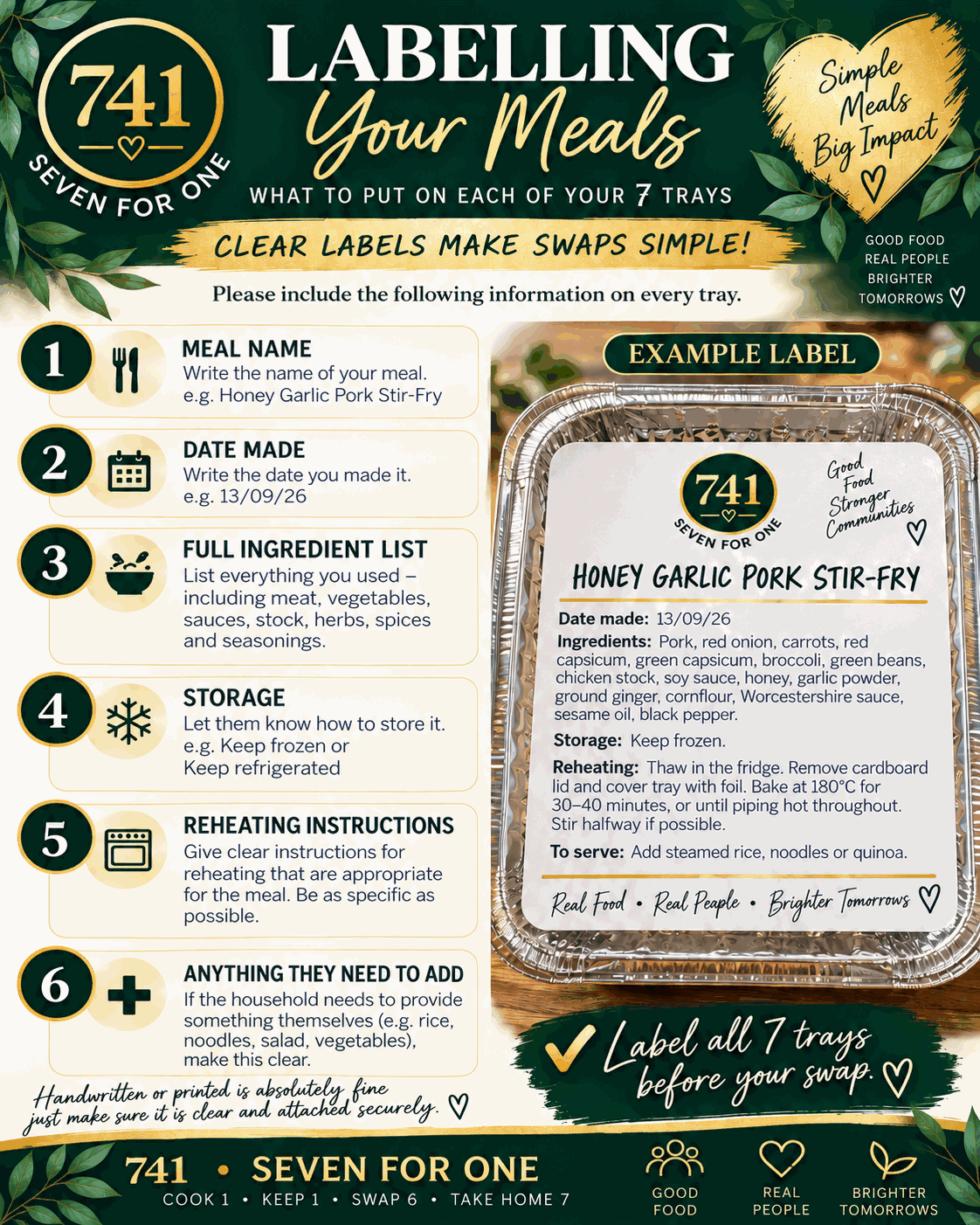
Each meal should also be clearly labelled with the meal name, relevant ingredients or allergens, date, storage information and reheating instructions.
The seven households in each hub can talk openly about any concerns and agree on the standards they are comfortable with before they begin swapping. If someone would feel more comfortable starting with people they already know, they can absolutely form a 741 hub with their own friends or family.
741 works because people are cooking for one another with the same care they would want shown to their own household.
Not necessarily.
If your hub chooses to do fresh swaps, meals should be prepared within the 24 hours before the swap, cooled safely and refrigerated promptly. Once cooked, meals should be refrigerated as soon as possible and within 2 hours, kept covered, and stored chilled until the swap.
If your hub decides to operate as a freezer hub, each household will need enough freezer space for the meals they are preparing and receiving.
Some hubs may also arrange their swap so everyone meets at the same time and exchanges meals directly, which can reduce the need for anyone to hold meals for other households.
The important thing is that each hub agrees on whether it will operate as a fresh-swap hub or freezer hub, and everyone follows the same safe storage expectations.
When a hub includes families with young children, it’s a good idea to talk about family-friendly meals and spice levels before the first swap.
Some recipes will naturally suit most children, while others may need a milder version or a simple adjustment, such as reducing chilli or adding spicy ingredients at serving time rather than into the whole batch.
The 741 recipe collection can help by identifying meals that are family friendly, family friendly with a mild adjustment, or better suited to households that enjoy stronger flavours.
Each hub can also agree on what works for its own members. The goal is to make sure the meals being swapped are actually useful and enjoyable for the households receiving them.
That’s something your hub can agree on together before swapping begins.
Dietary restrictions and allergies should always be taken seriously, but hubs can also discuss strong dislikes or ingredients that would make a meal unusable for someone in the group.
For example, our first Tuatapere hub is a no-mushroom hub because our family does not like mushrooms at all and will not eat food that has been cooked with them, even though it is not an allergy.
Another hub may be completely happy with mushrooms but choose to avoid something else, or agree that certain ingredients are optional or added separately.
The key is to agree on those preferences before people start cooking, so nobody ends up taking home meals they won’t eat.
741 works best when everyone has a voice in shaping the hub and the meals are genuinely useful to the households receiving them.
Every meal should be clearly labelled so the person receiving it knows exactly what it is and how to store and reheat it safely.
As a minimum, we recommend including:
If a meal is intended to be cooked from frozen, thawed first, or served with something separately — such as rice, noodles, pasta or bread — that should also be noted.
For dietary-specific hubs, it is especially important that ingredients are clear and that everyone checks the labels of packaged ingredients they use.
A simple, consistent labelling system makes the swap easier, safer and much less confusing once everyone gets their meals home.
A household does not necessarily have to fit into just one type of 741 hub.
For example, one person in a household may need dairy-free and keto meals, while everyone else has no dietary restrictions. In that situation, the household could potentially be part of two completely separate hubs.
For example, one person could join a single-serve dairy-free/keto hub, while the rest of the household could be part of a standard four-serve hub.
Each hub would operate independently, with its own serving size, recipes and dietary requirements.
The important thing is that the meals being swapped in each hub match the needs of the people receiving them.
As 741 grows, the website can help people find others in their area who need the same serving size and dietary requirements, making these more specialised hubs easier to form.
That way, one person’s dietary needs do not have to determine what the entire household receives.
4 QUESTIONS
The practical decisions each local group makes together.
No. 741 is designed so that each hub can operate locally and independently.
Once a group of seven households has formed, the people in that hub can decide together things such as:
We also recommend that every hub has a simple system for letting everyone know what they plan to cook each week before cooking begins. That could be through a group chat, shared list or another system that suits the hub. This helps avoid two households accidentally making the same meal for the same swap and gives everyone a better variety of dinners to take home.
One person may choose to act as the main contact or coordinator, but they do not need to carry the whole workload.
The 741 website is there to help people connect, access recipes, understand the system and get started, while the day-to-day running of each hub stays with the people who are actually part of it.
That way, 741 can grow across different communities without every swap needing to be centrally managed.
741 is about sharing proper home-cooked meals — the sort of dinner you would be happy to serve to your own household.
Meals should be nourishing, practical, suitable for the agreed serving size and able to be safely stored and reheated if needed. They do not have to be fancy or expensive. Simple family favourites are absolutely welcome.
Some meals may also include extras that complete the dinner, such as rice, noodles, pasta, bread or another suitable accompaniment. Where a hub has access to home-grown produce, excess garden vegetables or a local supplier willing to contribute fresh produce, those may also be shared alongside meals where appropriate.
These extras are a bonus rather than an expectation — the core contribution is still the agreed home-cooked meal.
What we want to avoid is one household putting in the effort to cook a full homemade dinner while another contributes something that is really just a packet, takeaway item or snack.
The aim is that everyone in the hub contributes with the same spirit: make something good, make it with care, and share it generously.
The simplest way is to agree on the expectations of the hub before the first swap.
Everyone should be working to the same serving size, contributing one proper home-cooked meal, and following the same general standards around quality, food safety, dietary requirements and packaging.
It also helps to keep communication open. If one recipe consistently costs much more than others, or if someone is regularly contributing less than the agreed amount, the hub can talk about it and make adjustments together.
741 is not about making every meal cost exactly the same. Some recipes will naturally be cheaper and some more expensive. The goal is that everyone contributes generously, consistently and in good faith so the swap feels fair over time.
Just as importantly, 741 works best when people cook with care and love for the others in their hub, rather than approaching the swap with a “what am I getting back?” mindset or assuming others are trying to take advantage.
The spirit of 741 is about trust, generosity and shared responsibility — making something you are proud to give, because you know the other six households are doing the same.
The aim isn’t to keep score. It’s to share the load well.
Each hub can choose the system that works best for them, but we recommend that everyone lets the rest of the group know what they plan to cook before the week’s swap.
That can be as simple as a group chat, shared list or message thread.
The main reason is to avoid two people accidentally making the same meal for the same swap and to help create a good variety of dinners across the week.
Some hubs may prefer to choose from the 741 recipe collection, while others may mix those recipes with trusted family favourites.
The important thing is simply that everyone communicates clearly before cooking begins.
4 QUESTIONS
Practical choices around affordability, packaging and the wider community helping a hub get started.
741 itself is not designed around membership fees. The main cost is simply the food you cook for your batch, plus any agreed packaging such as trays or containers.
Because each person is cooking one recipe in bulk, the cost per finished meal can often be much lower than cooking seven completely different dinners separately.
For example, in the Tuatapere five-serve hub, many of the bulk recipes have cost around $120–$140 to make seven family meals, which works out at roughly $17–$20 per meal, or around $3.40–$4 per serve.
Actual costs will vary depending on the recipe, serving size, meat prices, specials and where people shop. Each hub can also decide whether to use shared containers, reusable containers or another system that suits them.
The goal is not just to save money — it is also to reduce the mental load, planning and cooking time across the week.
No. Different recipes will naturally cost different amounts depending on the ingredients, season, specials and where people shop.
One week someone may cook a beef dish that costs more, while another person makes a chicken, sausage, soup or pasta-based meal that costs less. Over time, those differences will usually balance out.
The aim is not to make every meal match dollar-for-dollar. It is to make sure everyone contributes a proper, generous meal at the agreed serving size and approaches the swap in good faith.
Sometimes people may even choose to give a little more because they want to. For example, one week I spent around $200 on corned beef for our hub. I had already experienced savings in our grocery budget through 741 and wanted to use some of that saving to share the love with the other households in our hub.
That kind of generosity should never be an expectation, but it reflects the heart of 741 well: cook with care, give freely, and trust that everyone is contributing in the same spirit.
Buying in bulk, shopping specials, using seasonal produce and making use of home-grown vegetables or donated ingredients can all help keep costs manageable.
If a hub ever feels the difference in cost is becoming too large or unfair, the group can simply talk about it and agree on a reasonable approach together.
741 is about sharing the load — not keeping a running score of what everyone spent.
Yes. While 741 is a movement rather than a charity or business, local support can make a real difference, especially when a new hub is getting started.
Support might include things such as donated or discounted meat, vegetables, pantry ingredients, trays or containers, excess garden produce, freezer space, or practical help creating seed-stock meals.
That support can help reduce the initial cost of trialling 741 and make it easier for people to experience the system before committing to a regular hub.
Where appropriate, 741 can also acknowledge the businesses, growers or organisations that choose to support a local hub.
The heart of it is still the same: community helping community, so more people can share the load.
No. Each hub can decide what type of container works best for everyone.
Some hubs may choose foil trays because they are easy to portion, label, freeze and reheat. Others may prefer reusable containers, glass dishes, freezer-safe containers or another system that suits the group.
The important thing is that the hub agrees on the system before cooking starts, including whether containers are returned and reused, supplied individually, purchased together or covered through donations or community support.
Whatever is used should be food-safe, appropriate for the meal and suitable for the way it will be stored and reheated.
Using the same or similar-sized containers across a hub can also make portioning much easier and help ensure everyone is receiving the agreed serving size.
Still wondering something?
If your question is not answered above, send it through. Your contact details stay private. Questions that come up often may help shape future FAQs, but your personal details will not be published.
Thanks — your question has been sent through to 741.